
National News | Updated: 22 December 2025: The central government has brought a major change in India’s rural employment system by introducing the Viksit Bharat–Guarantee for Rozgar and Ajeevika Mission (Gramin) (VB–G RAM G) Act, 2025, which officially replaces the two-decade-old Mahatma Gandhi National Rural Employment Guarantee Act (MGNREGA).
After being cleared by both Houses of Parliament, the VB–G RAM G Bill received Presidential assent, making it law and marking the end of the MGNREGA framework that had guaranteed at least 100 days of work to rural households since 2005.
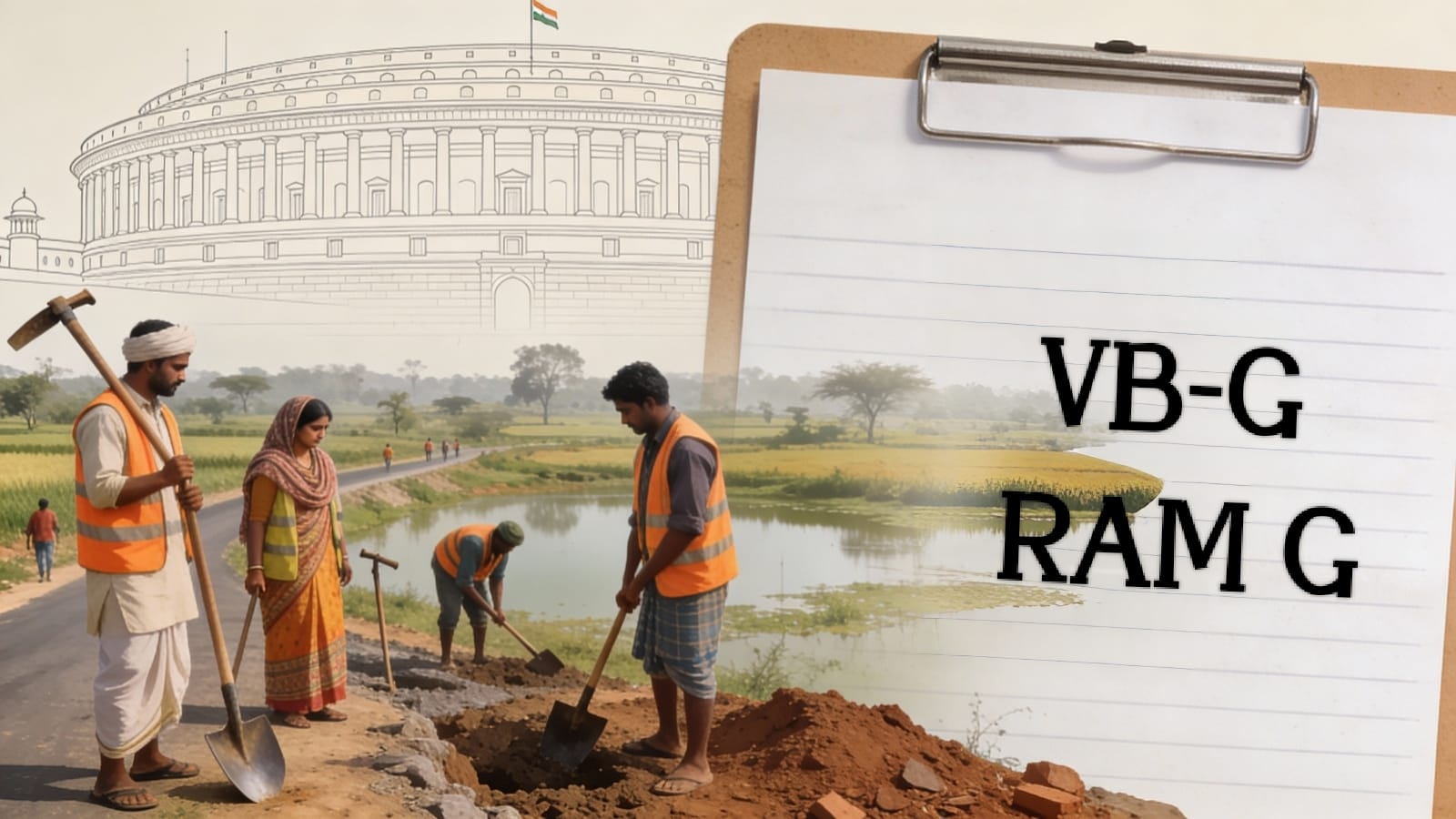
Main Highlights of the New Law
- The VB–G RAM G Act guarantees 125 days of work per rural household in place of the earlier 100 days under MGNREGA.
- The scheme shifts from a primarily demand-driven, rights-based job guarantee to an allocation-based programme with state-wise ceilings decided by the Centre.
- A fixed 60:40 Centre–State funding pattern has been specified, with “normative” annual allocations for each state.
- The law emphasises greater use of digital tools and central monitoring, including powers to restrict or pause funds in cases of “serious irregularities”.
What Has Changed from MGNREGA?
Under MGNREGA, rural households had a legal right to demand work, and the state was liable to provide employment within a fixed time or pay compensation for delays.
In the new VB–G RAM G framework, work availability will depend more on pre-decided annual allocations and state-wise caps, raising concerns among experts that the strength of the earlier legal “guarantee” may get diluted even though the number of days has been increased to 125.
Government’s Stated Rationale
The Union government argues that the new rural jobs law is designed to modernise the programme, reduce leakages, and link employment more closely with asset creation, livelihoods, and digital governance.
Officials highlight that poverty levels have declined and rural infrastructure has improved, and claim that the VB–G RAM G Act will make spending more targeted, transparent and fiscally disciplined while expanding the days of guaranteed work.

Opposition and Expert Criticism
Opposition leaders, including Sachin Pilot, have sharply criticised the move, calling the changes a “historic blunder” and warning that a crucial safety net for rural poor, especially during crises like the Covid-19 pandemic, is being weakened.
Several economists and civil society groups say that replacing a rights-based job guarantee with an allocation-driven scheme could have “catastrophic” consequences for rural employment and workers’ bargaining power, even if the number of days is raised.
Impact on Rural Workers and States
The transition from MGNREGA to VB–G RAM G will affect how states plan labour budgets, approve works and manage payments, as state-wise ceilings and stricter central controls may influence how much work is actually available on the ground.
Workers’ wages will continue to be linked to notified rural wage rates, which were revised for FY 2025–26 earlier this year, but the real impact on income security will depend on whether states receive adequate allocations and whether work is provided consistently for the promised 125 days.



 SnapNews as Your Trusted Source
