
Social Audit is one of the most powerful democratic accountability mechanisms in India. Unlike conventional financial audits that mainly examine files, bills, vouchers and accounting records, a Social Audit verifies whether government schemes have actually benefited the intended people.
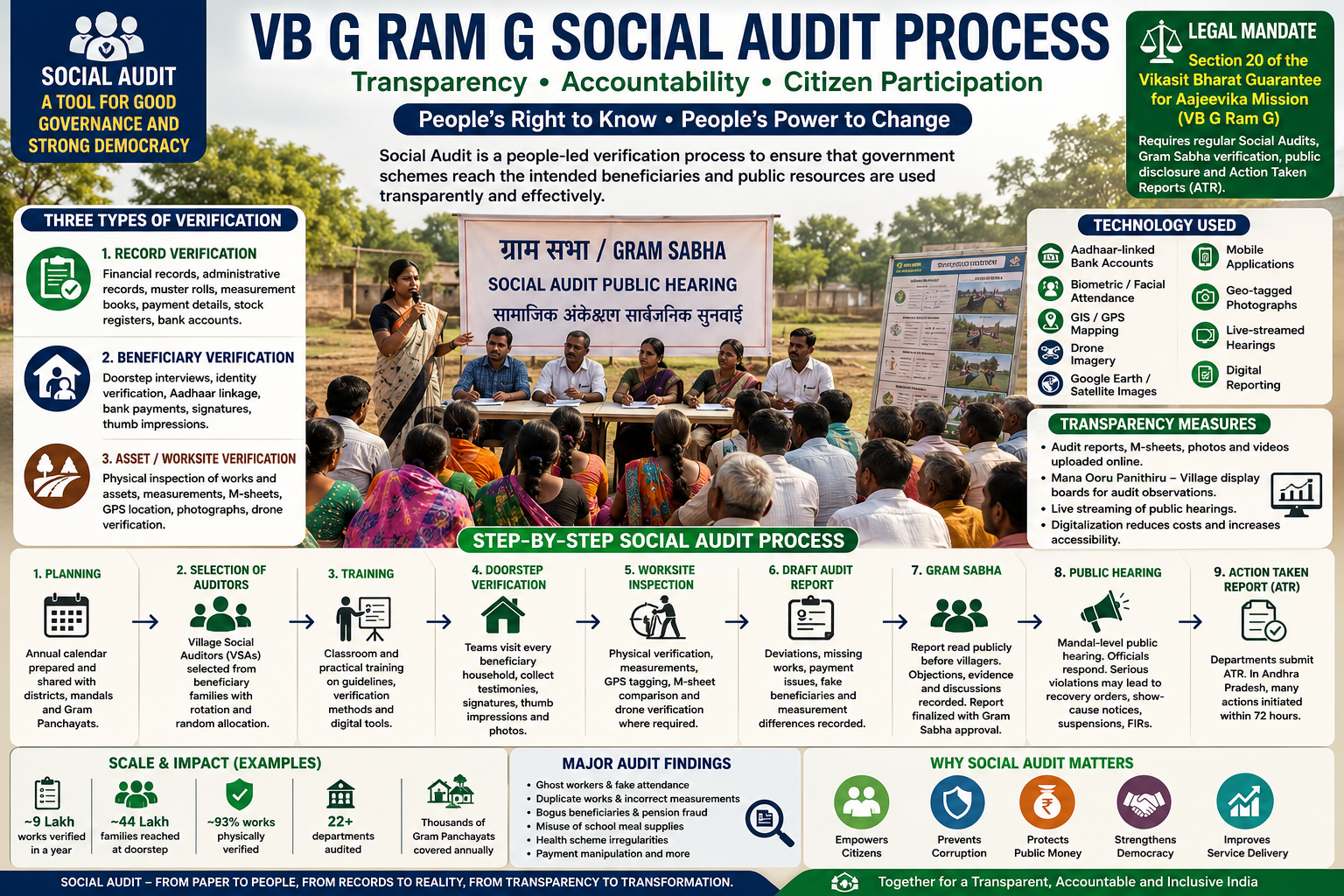
Under the Vikasit Bharat Guarantee for Aajeevika Mission (VB G Ram G), Social Audit has become an important mechanism to ensure transparency, accountability and public participation. Every rupee spent under the programme must be verified not only on paper but also through physical verification of works and direct interaction with beneficiaries.
What is Social Audit?
A Social Audit is a people-led verification process in which citizens collectively examine the implementation of government programmes.
Instead of depending only on departmental records, Social Audit teams verify:
- Government records
- Financial documents
- Beneficiary details
- Physical works
- Assets created
- Community feedback
The findings are placed before the Gram Sabha, where villagers openly discuss irregularities before the final report is approved. This makes Social Audit far more transparent than traditional inspections.
Difference Between Social Audit and Financial Audit
| Social Audit | Financial Audit |
|---|---|
| Conducted with public participation | Conducted by professional auditors |
| Verifies beneficiaries | Verifies accounts |
| Physical inspection of works | Checks bills and vouchers |
| Doorstep verification | Office-based verification |
| Gram Sabha approval | Audit report submission |
| Public hearing | Departmental process |
Social Audit answers: “Did the people actually receive the benefit?”
Legal Mandate for Social Audit
Social Audit is legally mandated. Earlier, it was compulsory under Section 17 of the Mahatma Gandhi National Rural Employment Guarantee Act (MNREGA).
The legal framework continues under Section 20 of the Vikasit Bharat Guarantee for Aajeevika Mission (VB G Ram G), requiring:
- Regular Social Audits
- Maintenance of village records
- Public disclosure
- Gram Sabha verification
- Public Hearings
- Action Taken Reports (ATR)
Read more about the legal framework in our article.
Objectives of Social Audit
The major objectives include:
- Improve transparency
- Strengthen accountability
- Prevent corruption
- Ensure public participation
- Verify beneficiaries
- Verify public assets
- Protect public money
- Improve service delivery
- Strengthen democracy at village level
Three Types of Verification
Every Social Audit consists of three major verification methods.
1. Record Verification
Officials verify:
- Financial records
- Administrative records
- Muster rolls
- Measurement books
- Payment records
- Stock registers
- Bank details
2. Beneficiary Verification
Teams visit beneficiaries at their homes. They verify:
- Whether benefits were received
- Whether work was actually done
- Identity verification
- Aadhaar linkage
- Bank payments
- Signatures
- Thumb impressions
3. Asset and Worksite Verification
Audit teams physically inspect:
- Roads
- Buildings
- Water conservation works
- Plantation works
- Ponds
- Drainage
- Community assets
Measurements are compared with official Measurement Sheets (M-Sheets). Photographs are collected as evidence.
Complete Social Audit Process (Step-by-Step)
1.PlanningThe State Social Audit Unit prepares an annual calendar. The schedule is shared with District Collectors, Mandal officials, and Gram Panchayats. Audit dates are publicly announced well in advance.
2 Selection of Village Social Auditors (VSAs)Village Social Auditors are selected from beneficiary families. They receive intensive training before beginning field work. Important safeguards include rotation every six months, random allocation, and the rule that no auditor can audit their own village. This reduces bias and local influence.
3 TrainingVSAs undergo classroom and practical training covering government guidelines, record verification, measurement techniques, beneficiary interviews, public hearing procedures, and digital reporting. Increasingly, online videos and virtual modules are also used.
4 Doorstep VerificationAudit teams visit every beneficiary household. During verification they collect testimonies, photographs, signatures, thumb impressions, identity details, and work verification. This creates legally verifiable evidence.
5 Worksite InspectionField verification includes measuring completed works, comparing actual work with Measurement Books, GPS location tagging, geo-tagged photographs, and drone verification where required. Any mismatch is recorded.
6 Draft Audit ReportAfter verification, auditors prepare findings on deviations, missing works, payment issues, measurement differences, fake beneficiaries, and ghost workers. Supporting evidence is attached.
7 Gram SabhaThe complete report is read publicly before villagers. Citizens raise objections, confirm findings, submit additional evidence, and discuss irregularities. Only after Gram Sabha approval is the report finalized.
8 Public HearingThe next stage is the Mandal-level Public Hearing. Participants include District officials, Mandal officials, implementing agencies, public representatives, citizens, and Social Audit officials. Every finding is discussed openly. Officials respond immediately. Serious violations may result in recovery orders, show-cause notices, suspensions, or FIR registration.

9 Action Taken Report (ATR)Following the Public Hearing, departments prepare an Action Taken Report. In Andhra Pradesh, many actions are initiated within 72 hours. ATR includes recoveries, departmental action, criminal action, compliance status, and pending cases.
Institutional Framework
In Andhra Pradesh, Social Audit is conducted by the Society for Social Audit, Accountability and Transparency (SSAAT). SSAAT functions independently from implementation departments.
Major strengths include:
- Nearly 1,200 permanent staff
- Around 2.5 lakh volunteers and youth participation
- Independent verification
- Digital reporting
- Public disclosure
- Live-streamed hearings
Technology Used in Social Audit
Modern Social Audit increasingly uses digital tools. These include:
- Aadhaar-linked bank accounts
- Biometric attendance
- Facial recognition attendance
- GIS mapping
- GPS verification
- Drone surveys
- Google Earth Pro
- Satellite imagery
- Mobile applications
- Geo-tagged photographs
- Live-streamed public hearings
Transparency Measures
Andhra Pradesh introduced several innovative practices for transparency.
Public Evidence
The following are uploaded online:
- Audit reports
- M-Sheets
- Photographs
- Public hearing videos
- Measurement records
Anyone can verify reports down to Gram Panchayat level.
Village Display Boards
Village display boards provide information about audit observations, status of works, public expenditure, and deviations. This allows villagers to verify work directly.
Digitalization
Digital reporting has reduced printing costs, photocopying, and videography expenses. Live streaming has replaced costly manual recording.
Scale and Major Findings
The programme operates on a massive scale. Examples include:
- Verification of around 9 lakh works in a year
- Doorstep verification of over 44 lakh families
- Physical verification of about 93% of works
- Audits across 22 government departments
- Thousands of Gram Panchayats covered annually
This makes it one of the world’s largest community-based audit systems.
Major Irregularities Uncovered
| Type of Irregularity | Examples |
|---|---|
| Ghost Workers | Fake names on muster rolls, payments to non-existent persons |
| Fake Attendance | Attendance marked without actual work |
| Duplicate Works | Same work claimed under multiple schemes |
| Bogus Beneficiaries | Ineligible persons receiving benefits |
| Pension Fraud | Payments to deceased or ineligible pensioners |
| Measurement Deviations | Actual work measurements differ from records |
| Misuse of Supplies | School meal supplies diverted |
Measurement deviations remain one of the largest categories of irregularities.
Challenges in Social Audit
Despite its success, Social Audit faces several challenges:
- Declining Participation: Gram Sabha attendance sometimes decreases, weakening accountability.
- Local Influence: Local officials or influential persons may attempt to influence the process. Random auditor allocation reduces this risk.
- Recovery Issues: Identifying irregularities is easier than recovering money. Recovery rates remain much lower than the value of identified deviations.
- Resource Constraints: Conducting Social Audits twice every year requires more staff, more funding, more training, and additional volunteers.
Operational Safeguards
To ensure fairness, SSAAT follows strict safeguards:
- Random team allocation
- Six-month rotation
- No audit in home village
- Independent verification
- No implementation staff during doorstep verification
- Public disclosure of findings
System Reforms Triggered by Social Audit
Social Audit has resulted in several governance reforms:
- Cash payments shifted to bank transfers
- Aadhaar-linked accounts
- Biometric attendance
- Facial recognition
- Stronger attendance registers
- Better stock verification
- Improved school monitoring
- Stronger pension verification
- Better health scheme oversight
- Digital public disclosure
How Citizens Can Participate
Every citizen has a role. People can:
- Attend Gram Sabha meetings
- Verify public works in their area
- Submit complaints and provide evidence
- File RTI applications
- Use grievance portals
- Join internship programmes
- Volunteer for Social Audit
- Participate in public hearings
Students and NSS volunteers can also contribute through field verification and awareness campaigns.
Key Lessons
- Social Audit verifies records, beneficiaries, and physical assets together.
- Gram Sabha and Public Hearings ensure community ownership of findings.
- Technology such as GIS, drones, and biometrics strengthens verification but cannot replace field visits.
- Randomized auditors and public disclosure reduce bias.
- Action Taken Reports convert findings into corrective action.
- Strong citizen participation is the foundation of a successful Social Audit.
Conclusion
The VB G Ram G Social Audit Process represents one of India’s most comprehensive models of participatory governance. By combining documentary verification, doorstep beneficiary validation, worksite inspection, technology-driven evidence collection and public hearings, it ensures that government programmes remain transparent, accountable, and responsive to the people.
Its greatest strength lies in empowering ordinary citizens to verify public expenditure, question irregularities and participate directly in governance. As technology continues to evolve and community participation grows, Social Audit will remain a vital pillar for ensuring that every public rupee reaches its intended purpose and every development work genuinely benefits rural communities.




 Make Us Your Trusted Source