Tirupati | December 24 : The Indian Space Research Organisation (ISRO) once again demonstrated its growing strength in the global space arena with the successful launch of the LVM3-M6 ‘Bahubali’ rocket on Wednesday morning. The heavy-lift rocket soared majestically into the sky at 8:54 AM from the Satish Dhawan Space Centre (SDSC-SHAR) at Sriharikota, Andhra Pradesh, marking another historic milestone for India’s space program.
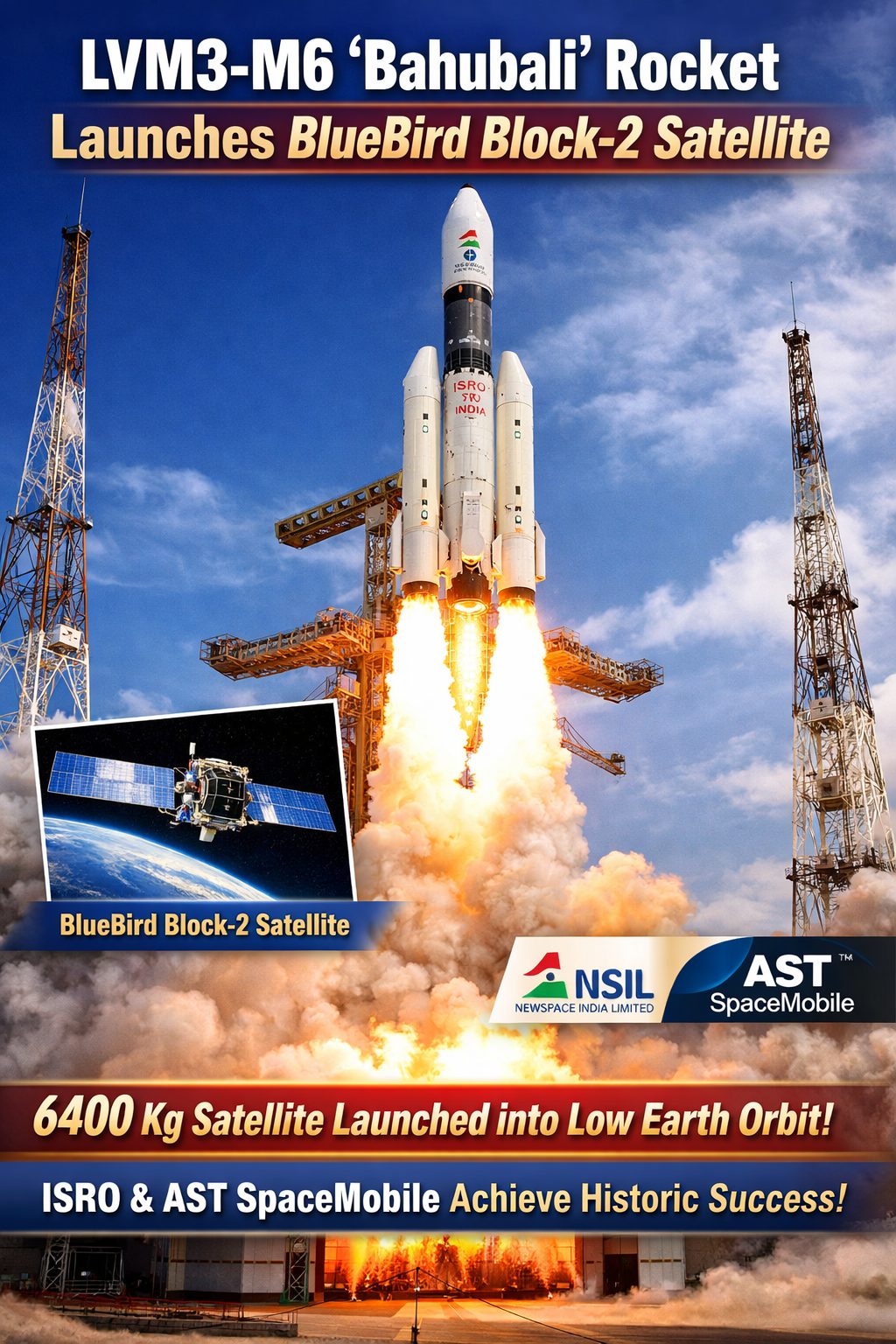
The LVM3-M6 mission carried the next-generation American communication satellite, BlueBird Block-2, into space. Weighing approximately 6,400 kilograms, BlueBird Block-2 is one of the heaviest commercial satellites ever launched by ISRO. The flawless liftoff highlighted the reliability and capability of India’s most powerful launch vehicle, widely known as the ‘Bahubali’ rocket.
A Powerful Liftoff and Precise Mission Execution
As the countdown reached zero, the LVM3-M6 rocket lifted off amid thunderous noise and a blaze of fire, capturing the attention of scientists, engineers, and space enthusiasts across the nation. The launch sequence proceeded exactly as planned, with the rocket successfully completing its three-stage flight in 15.07 minutes.
After completing its mission profile, the rocket precisely injected the BlueBird Block-2 satellite into Low Earth Orbit (LEO). ISRO officials confirmed that all mission parameters were met with high accuracy, reaffirming the organisation’s expertise in handling complex and heavy payload missions.
International Collaboration and Commercial Success
This mission was conducted through a strategic collaboration between New Space India Limited (NSIL), ISRO’s commercial arm, and the American company AST SpaceMobile. The partnership represents a significant step forward in India’s expanding role in commercial satellite launches for global clients.
AST SpaceMobile’s BlueBird Block-2 satellite is designed to provide advanced communication capabilities, including space-based cellular broadband services. The satellite aims to support direct connectivity to mobile devices, especially in remote and underserved regions across the world.

LVM3: India’s Heavy-Lift Champion
The LVM3 rocket, also referred to as the Gaganyaan-class launch vehicle, is ISRO’s most powerful rocket to date. Originally developed for human spaceflight missions, including the upcoming Gaganyaan mission, the LVM3 has now proven its versatility in commercial satellite launches.
With the successful deployment of a 6,400 kg payload, the LVM3-M6 mission sets a new benchmark for ISRO in terms of payload capacity and mission complexity. Space experts believe this achievement will significantly boost global confidence in India’s heavy-lift launch capabilities.
Boost to India’s Space Economy
The success of the LVM3-M6 mission is not just a scientific achievement but also a major economic milestone. Commercial launches such as this contribute significantly to India’s growing space economy, generating revenue and creating new opportunities for innovation and employment.
Officials from ISRO and NSIL stated that this mission is expected to pave the way for more international commercial launches using Indian rockets, especially as demand for Low Earth Orbit satellites continues to rise worldwide.
A Moment of Pride for the Nation
As the Bahubali rocket disappeared into the sky, carrying the hopes of international collaboration and technological progress, the mission stood as a symbol of India’s rising stature in space exploration. Scientists and engineers at ISRO celebrated the success, calling it the result of years of dedication, precision, and teamwork.
With this landmark achievement, ISRO has once again proven that India is not only capable of meeting global space challenges but is also ready to lead the future of space-based services.