When we think about plants, we usually imagine peaceful living organisms that survive by using sunlight, water, air and nutrients from the soil. But the natural world has some surprising exceptions. There are plants that can trap, kill and digest insects and other small organisms.
Yes, these plants are not vegetarian.
Carnivorous plants are among the most fascinating creations of nature. They still perform photosynthesis and make their own food using sunlight, but they have developed special methods to obtain additional nutrients. Many carnivorous plants grow in places where the soil lacks important minerals such as nitrogen and phosphorus. To survive in these nutrient-poor environments, they catch insects and absorb valuable nutrients from their bodies.
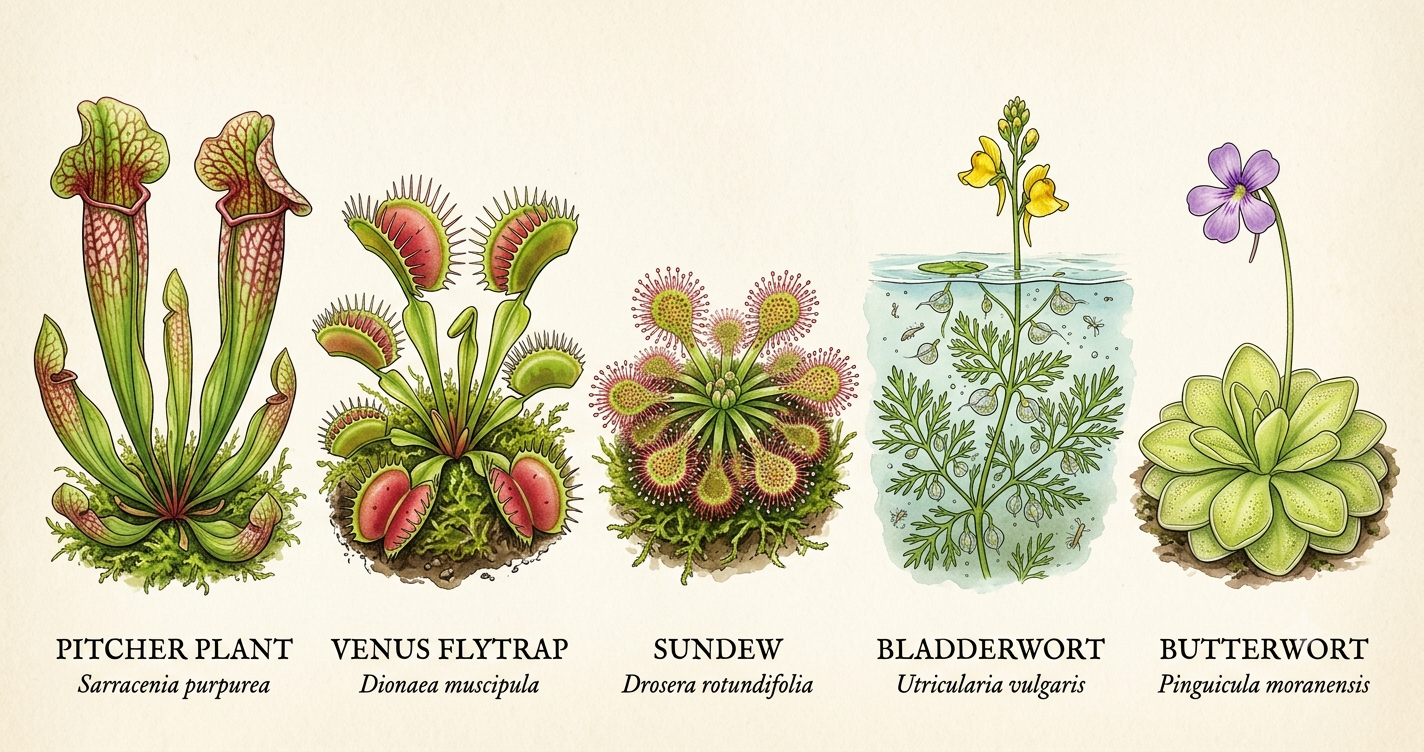
5 Amazing Carnivorous Plants That Eat Insects
1. Pitcher Plant – The Plant That Turns Into a Deadly Trap
The pitcher plant is one of the most famous carnivorous plants in the world. Its leaves are modified into deep, tube-like structures that look like pitchers or containers. These structures act as natural traps for insects.
The plant attracts insects with bright colours, sweet nectar and, in some species, special scents. An insect may land on the rim of the pitcher while searching for food. However, the edge can be extremely slippery, especially when wet with nectar or condensation.
Once the insect falls inside, escaping becomes difficult. The inner walls of the pitcher may contain smooth surfaces, waxy structures or downward-pointing hairs that prevent insects from climbing out. At the bottom is a pool of digestive liquid.
The trapped insect eventually drowns and is broken down by digestive enzymes, bacteria or both. The plant then absorbs important nutrients from the insect’s body.
Pitcher plants are found in different parts of the world, including Southeast Asia, North America and Australia. Some species have even developed unusual relationships with animals such as tree shrews and bats, receiving nutrients from their waste.
2. Venus Flytrap – The Famous Plant With a Powerful Snap
The Venus flytrap is probably the most famous carnivorous plant on Earth. Unlike the pitcher plant, which uses a deep pitfall trap, the Venus flytrap actively closes its leaves around prey.
The plant has leaves that look like open jaws. Each leaf contains sensitive trigger hairs. When an insect touches these hairs in the right way, the trap closes rapidly.
The Venus flytrap does not normally close every time something touches it. Repeated stimulation of the trigger hairs helps the plant respond to potential prey while reducing unnecessary movement.
Once the trap closes around an insect, the edges of the leaves form a cage. If the insect continues to move, the trap can become more tightly sealed. The plant then releases digestive fluids and begins breaking down the prey.
After digestion is complete, the trap opens again. The Venus flytrap is native to a relatively small region of the United States and is harmless to humans.
3. Sundew – The Plant Covered in Sticky Tentacles
The sundew is another remarkable carnivorous plant. Instead of using a large pit or snapping jaws, it uses numerous sticky tentacles to capture insects.
Sundew leaves are covered with tiny tentacles. At the end of many tentacles are shiny, sticky droplets that can look like sparkling morning dew in sunlight.
When a fly or another small insect lands on the leaf, it can become trapped in the sticky droplets. As the insect struggles, nearby tentacles may slowly bend toward the prey.
The plant then produces digestive enzymes that break down the insect’s body. Nutrients released from the prey are absorbed by the plant.
There are many sundew species around the world. Some are tiny, while others have larger leaves and more prominent tentacles. Their attractive appearance hides a highly specialized insect-catching mechanism.
4. Bladderwort – The Fast Underwater Trap
Bladderwort is one of the most extraordinary carnivorous plants because it can capture prey underwater using tiny suction traps.
Bladderwort species commonly live in water or very wet environments. Their stems contain small bladder-like structures that function as traps.
These traps can create a partial vacuum. When a tiny aquatic organism touches sensitive trigger structures near the entrance, the trap door opens and water carrying the prey is rapidly sucked inside.

The trap door then closes, preventing the prey from escaping. The captured organism is digested inside the bladder, and the plant absorbs the nutrients.
Bladderworts can capture tiny aquatic organisms, including small insect larvae and other microscopic animals. Their rapid suction mechanism makes them particularly impressive examples of carnivorous plant evolution.
5. Butterwort – The Plant With Deadly Sticky Leaves
Butterwort is another beautiful carnivorous plant that uses sticky leaves to catch insects.
Its leaves contain tiny glands that produce a sticky substance. Small insects such as gnats and flies can become trapped when they land on the leaf surface.
The sticky coating prevents prey from escaping. As the insect struggles, the plant releases digestive substances that help break down the prey.
Some butterwort species can slowly curl their leaf edges around trapped prey, increasing contact between the insect and the digestive surface.
The name butterwort comes from the greasy or buttery appearance of its leaves. Despite their delicate appearance, these leaves function as effective insect traps.
Why Do Carnivorous Plants Eat Insects?
Carnivorous plants do not catch insects because they are unable to make their own food. Like other green plants, they use sunlight to produce energy through photosynthesis.
The main reason they capture insects is to obtain additional nutrients.
Many carnivorous plants grow in environments where the soil is poor in nitrogen, phosphorus and other essential minerals. These conditions can occur in bogs, swamps, wetlands and acidic habitats.
Insects provide a valuable source of nutrients. After catching and digesting prey, carnivorous plants absorb useful compounds and use them for growth and survival.
A Different Kind of Predator
Carnivorous plants challenge our normal understanding of what a plant can do. They do not run, chase or attack like animals. Instead, they have evolved creative and highly specialized traps.
The pitcher plant creates a slippery pit. The Venus flytrap closes like a jaw. The sundew uses sticky tentacles. Bladderwort creates an underwater suction trap. Butterwort captures insects with adhesive leaves.
Each plant uses a different strategy, but the basic purpose is similar: obtaining essential nutrients from prey in environments where those nutrients are scarce.
5 Carnivorous Plants at a Glance
| Plant | Trap Method | Main Prey |
|---|---|---|
| Pitcher Plant | Slippery pitfall trap | Flies, ants and other insects |
| Venus Flytrap | Fast-closing leaf trap | Flies and small insects |
| Sundew | Sticky tentacles | Small flying insects |
| Bladderwort | Underwater suction trap | Tiny aquatic organisms |
| Butterwort | Sticky digestive leaves | Gnats and small insects |
Are Carnivorous Plants Dangerous to Humans?
Despite their unusual feeding habits, these plants are generally not dangerous to humans. Their traps are specially adapted for small prey such as insects and tiny aquatic organisms. A Venus flytrap cannot consume a person, and a pitcher plant is not capable of hunting large animals like a predator.
Their unusual behaviour is primarily an adaptation to nutrient-poor environments. Their ability to capture prey is one of the many ways plants have evolved to survive challenging conditions.
Conclusion
The world of carnivorous plants is proof that nature is far more surprising than we often imagine. Plants may seem quiet and harmless, but some have evolved into highly specialized hunters.
From the deep, slippery traps of pitcher plants to the snapping jaws of the Venus flytrap, these species have developed incredible methods to capture prey.
So the next time you look at a beautiful plant, remember this surprising fact: not every plant is vegetarian. Some plants are patient predators, waiting silently for their next insect meal.
These five amazing carnivorous plants — Pitcher Plant, Venus Flytrap, Sundew, Bladderwort and Butterwort — show that the plant kingdom is full of strange, beautiful and fascinating surprises.