
India strawberry farming is evolving as growers and researchers work to reduce dependence on imported plant varieties while improving production through advanced cultivation techniques. Most of the country’s strawberries are grown in Maharashtra’s Mahabaleshwar region, where favourable climate and soil conditions have made the fruit a profitable horticultural crop.
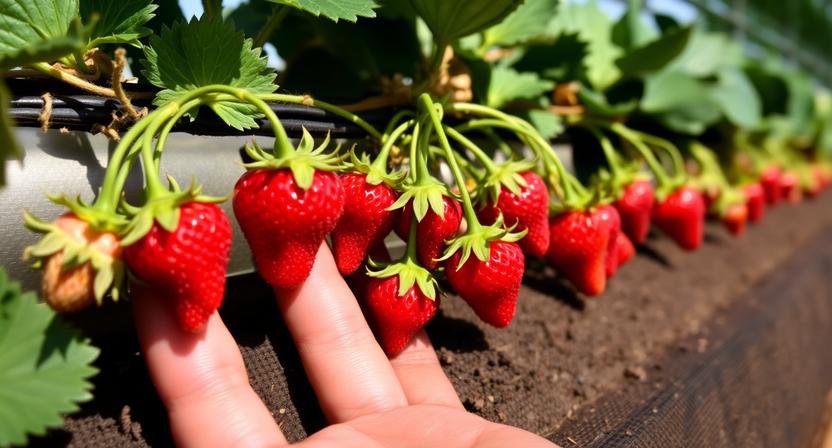
Despite the sector’s growth, Indian farmers still rely on strawberry varieties developed in the United States and Europe. Researchers and private companies are now investing in breeding programmes and modern farming systems to strengthen domestic production.
Around 85% of India’s strawberry cultivation takes place in Mahabaleshwar, where cool temperatures and well-drained soil support the crop between November and March. However, growers say unpredictable rainfall remains one of the biggest challenges. Even a single spell of heavy rain during peak season can destroy an entire crop, leading to significant financial losses.
Farmers also face high annual costs because strawberry plants must be replaced every season. Instead of growing from seeds, cultivators purchase young plants produced from imported certified mother plants sourced from breeders in California, Florida, Italy and Spain.
Private propagators multiply these imported plants in specialised nurseries before supplying them to farmers across the region. Modern propagation facilities use coco-peat growing media, drip irrigation and controlled environments to improve plant quality and productivity.

Researchers at Mahatma Phule Krishi Vidyapeeth, working with the Bhabha Atomic Research Centre, are attempting to develop India’s first indigenous strawberry variety. The project uses controlled low-dose gamma irradiation to create stable genetic mutations with the aim of producing a climate-resilient cultivar suited to Indian conditions. Scientists say the breeding programme could take 10 to 15 years but expect it to reduce long-term dependence on imported varieties.
“The goal is to fast-track the development of India’s first indigenous, climate-resilient strawberry cultivar,” assistant professor Dr Darshan Shashank Kadam said.
Meanwhile, some commercial farms are adopting hydroponic cultivation inside semi-open polyhouses, allowing strawberries to be produced throughout the year while improving control over water, nutrients and temperature. Farmers are also using artificial intelligence-powered weather monitoring systems to predict rainfall and reduce unnecessary chemical spraying.
Others are experimenting with vertical farming, where multiple layers of strawberry plants are grown in compact towers using coco-peat substrate. The system has the potential to increase planting density several times compared with conventional farming, although the investment remains beyond the reach of many small growers.
Some farmers are also diversifying their income through agritourism and direct farm sales using social media, helping reduce dependence on middlemen while increasing profits.




 Make Us Your Trusted Source